Saturday, July 14, 2012

Volume 7, Number 10: Misplaced Priorities, Lies and Ruined Lives

Just under six months ago, when former Penn State University head football coach Joe Paterno died, just two months after being fired, I expressed sympathy for a man who said he wished he could have done more regarding the monstrous behavior of Gerald Sandusky, his defensive coordinator.  In particular, he said he had told athletic director Tim Curley about what assistant coach Mike McQueary had seen involving Victim #2, and had expected things to go up the "chain of command."  I said something about how tragic it was to lose your dream job, get sick and die in such a short span of time.**

However, in light of the report released two days ago by ex-FBI director Louis Freeh following his law firm's investigation of Penn State's handling of Sandusky, I now see that Paterno's fall from grace was no Greek tragedy.  Far from it.  He lied – lied behind the victims' backs, lied to a grand jury, lied to the media and lied to the public – regarding his role in the whole affair.  He did do more than report about Victim #2... but it was the bad kind of "more"; he took an active role, working with Curley, vice-president Gary Schultz (who, incidentally, was once in charge of overseeing PSU's police department) and president Graham Spanier in covering up Sandusky's wrongdoing, and worse, allowing him continued contact with young boys.  Based on the evidence presented in the Freeh Report, all four men cared more about controlling damage to their university, and especially its football program, than about controlling damage to innocent young lives.


There are questions about where to proceed from here, such as what to do with the bronze statue of Joe Paterno (some say to remove it; other suggest turning it around so he faces backward; I personally liked the suggestion that since he was part of the cover-up, that his statue should be covered up as well).  In particular, the debate has already begun on the matter of how the NCAA should punish Penn State.  A few people have said that the football program should stay up and running because the people presently associated with it were neither child molesters nor part of the cover-up; furthermore, shutting down the program theoretically could cause economic damage to the surrounding community.

I disagree. The NCAA needs to send a loud and clear message to all its members about what happens when higher-ups try to cover up a mess. Paterno, Curley, Schultz and Spanier were so concerned about their football program and its image that they allowed–and enabled–Sandusky to continue molesting young boys. The message I hope NCAA sends should be something like:
“If you put your football program so far above everything else that you’re willing to sacrifice your morals, or ignore the cries of innocent people, then you should spend some time without said program so you can re-evaluate your priorities.”
Not to be comparing this scandal to the one that SMU had – their problem was money, not molestation – but seeing as both SMU and PSU allowed wrongdoing to go on repeatedly over an extended period of time, and covered it up as best as they could, maybe PSU should be shut down for two years (as SMU was in 1987-88). Or at the very least, no home games for two years – if PSU wants to play football, it would have to do so on the road.

**As an aside, one of my Facebook friends said Paterno was evil, and in particular, that he covered up a crime (which I refused to believe) and that anyone who expressed sympathies like that was evil as well.  He then un-friended me.  (No big loss – calling me evil was superficial, immature and uncalled-for, and as Obi-Wan Kenobi said, "Only a Sith deals in absolutes.")

Saturday, June 16, 2012

Volume 7, Number 9: Onward and Upward, Part II


Holy crap!

I had thought that there would be some sort of poll set up to determine favorite entries in the recent Astros Uniform Design Contest first, but actually, Paul Lukas (head of Uni-Watch) picked his "five best" entries--out of about eight dozen--earlier this week and posted them here on June 14.

I was absolutely stunned. I knew deep down that my design kicked ass, but didn't know just how much ass it would kick.  To get such a distinction from such a longtime uniform connoisseur as Paul, that is a heck of an honor.

Here's what Paul had to say about my entry:
"Most of the design submissions included some version of the Astros' old tequila sunrise rainbow striping, but only Rabinowitz came up with the idea of restricting it to piping and trim. It's a clever approach, and it totally works -- a good visual reference to the team's past without being a slavish re-creation. The rainbow-outlined star logo is nice, too. Let's hope the team's real uniform for next year turns out to be half this good."
It got me thinking... I need to design more unis in my spare time, just to build a reputation for what I stand for in my designs... a balance of tradition and progress... clean, structured, clutter-free designs... and most of all, when I design something, I want something that will stand the test of time--I couldn't care less about what's "in" at the moment--so that when there's a change in the team's ownership or management, they won't be as interested in overhauling the uniforms as they should be in fixing the team.

(Note: The entries were listed in the alphabetical order of the designer's first name, so my being #3 doesn't mean I was Paul's third choice, just that "Mark" is third in that particular order.)

Monday, June 11, 2012

Volume 7, Number 8: Onward and Upward:
My Concept for the Houston Astros' Logo and Uniforms

Recently, the Houston Astros announced that they will move to the American League next season, and to go with their new league, they would also get new uniforms. With that in mind, Paul Lukas, ESPN.com's writer for all things related to sports logos and uniforms, announced on May 31 that Uni-Watch (a sort of online community obsessed with sports logos and uniforms) would hold an Astros uniform design contest.

It's not an official contest; for all I know, the Astros' ownership and management may not consider any of the over 100 submissions that have come in for this contest. The point is, I had been waiting with baited breath for ages for such a contest, because all this time, I've had a design in mind that incorporates a number of elements from past uniforms, yet keeps in mind the spirit of astronauts--exploration, experimentation, "pushing the envelope," looking to the future.

The seed for the design was planted when the Astros unveiled their current unis over 10 years ago.  I hated that design, but only because it looked better-suited for a team whose theme was "the Old West," not "astronauts."

You may recall that I've entered in a Uni-Watch contest before; my Tigers road jersey concept ended up finishing 13th out of 94 entries in a 2010 contest.

Without further ado, I give you my design concept. Click on the picture below to see it in full size. Further down this blog entry is an explanation of various details in my concept.


Cap logo: I've liked the star with the two sides missing since it debuted in 1995, but the first two renditions (1995-99, 2000-present) missed the mark. The first one looked way too much like the logo Lockheed Martin was using. The second, well, it didn't look too distinctive at all. And both were missing the all-important "H" for Houston that the 1965-1994 Astros had on their caps--such an omission would be fine if it was a team that was looking to move elsewhere, but the Astros, obviously, aren't. I wanted to bring that "H" back. I also wanted a star that was flying upwards like a rocket to match the "onward and upward" future-minded spirit of the space program. I hope that the upwards-shooting star doesn't remind anyone too strongly of a certain series of NBC public service announcements. Heck, the far left side of that upwards-shooting star may even remind some of the left end of the airfoil you see in the classic (and current) NASA logo.

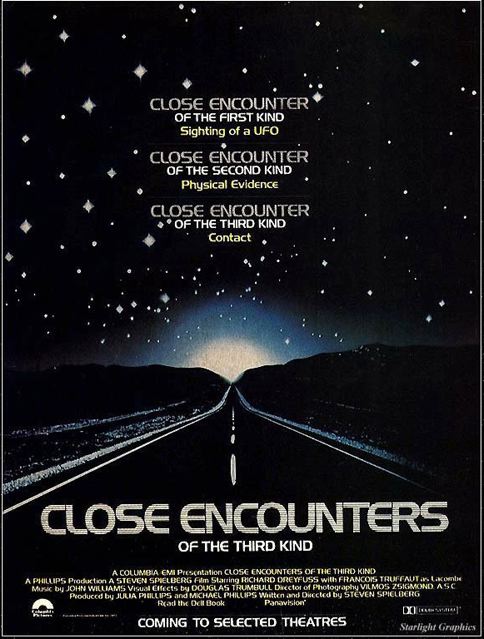
Wordmarks/numerals: The font is derived from a font you have already seen from Close Encounters of the Third Kind (1977), Pepsi (late 1980s) and Star Trek: Deep Space Nine (1993-99). (That font definitely enhances the future-minded look I wanted to capture). I added some blocky serifs to it to give it a "Texas accent," and it may even remind you of the "HOUSTON" wordmark that the Astros once used on their road jerseys (1965-74). The wordmarks on the home and road jerseys swoop upwards--kind of like the Planet Hollywood logo or the logo the Seattle Sonics used in the 1990s--to match the upwards-shooting star and enhance that "onward and upward" spirit.

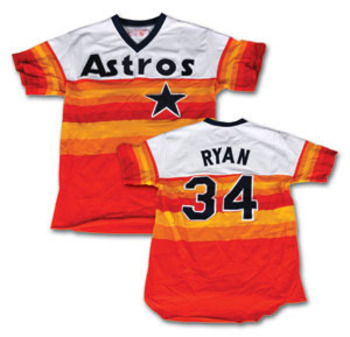
The proof is in the piping: You knew that the "tip of the cap" to the "tequila sunrise" jerseys had to come in somewhere. I never considered using the 1975 "tequila sunrise" design as a base for my design; still, those orange-and-yellow stripes are a part of Astros' history and I wanted to incorporate them some way. So after much deliberation, I decided to give that tribute in the form of piping--namely, three-striped piping (similar to the blue-red-blue piping you see on the Atlanta Braves' jerseys) made from the Astros' new colors: Navy blue, bronze and gold.

But wait, Mark, did you say "bronze and gold"? I didn't want to use orange and yellow; not when their metallic equivalents are available here in the 21st century. Bronze and gold go so well with navy blue and they shine like the stars (OK, maybe that last part sounded corny). Besides, metals are tough and yellow is a color you often find on bruises. The upwards-shooting star is also bronze and gold to add to that aforementioned "tequila sunrise" tribute.

So there you have it. I'd love to see these unis become solid reality next year, but as I said, it's not an official contest. For all I know, the Astros may have already shelled out mucho dinero for some sports marketing firm to come out with turkeys like the ones they brought out 12 years ago. I wonder why sports franchises even bother. The Uni-Watch community is so much smarter and could provide a whole slate of design concepts.

Wednesday, May 23, 2012

Volume 7, Number 7: Ramen Noodles — The End of an Era

Like most people, I discovered ramen noodles when I was young and didn't know better.  They appealed to two of my core values:

  • Self-reliance: I loved the idea of making my own hot lunches without having to hassle my mother (so I was willing to try anything that had easy-to-follow microwave directions on the package), and
  • Frugality: I also loved the idea that you could get a hot lunch for less than the price of a postage stamp

I don't know what appealed to me the most about them—the texture of the noodles, the taste, or the price—but whatever it was, after trying and liking them, I was determined to try every flavor there was (except "mushroom", because I hate mushrooms), and when I started living on my own, I had them at least once every week (usually on Saturday; during my college years, I'd often find myself watching college football and eating ramen at the same time, so ramen wound up being a Saturday tradition).  I even pined for different flavors that don't presently exist.

But ramen noodles have a few problems:

  • Like most cheap foods on the market today, they're not very substantial.  They're almost 60% carbohydrates, which leads to one of two undesirable results: One, if you take in more carbs than your body can burn, the excess carbs get converted into fat; or two, your body does burn them but you end up feeling hungry a lot sooner than if you had taken something more substantial.
  • They have some fat in them, too.  For example, the Lime Shrimp flavor has 7 grams of fat per serving (so roughly 16% of that serving is fat).
  • And there's a lot of salt in that flavor packet.

I was ignorant of those drawbacks up until recently.  I realized that I had successfully lost weight by cutting way back on carbohydrate-heavy junk foods and switching from regular soda to diet, and late last year, I began cutting way back on pre-sweetened cereals.  But even then, I had stuck with ramen every Saturday.

Until last Saturday.  The last package of ramen I had was my undisputed favorite flavor, Maruchan's Lime Shrimp.

So long, ramen.  I may have you again when you come out in some new flavor (like "pizza" or "barbecue chicken" or "pepper steak" or "prawn cocktail").  Just so I can have the comfort of having tried that flavor.  But besides that scenario, that's it.  There are plenty of cash-strapped college students the world over to enjoy you anyway.

Next on the list to be phased out are these other high-carbohydrate, high-sodium soups that I happen to have in my house:

  • Campbell's condensed soups
  • Mrs. Weiss' Kluski Noodle Soup (another childhood favorite)
  • Lipton Noodle soups (yet another childhood favorite)

Friday, May 18, 2012

Volume 7, Number 6: A Quick Take on Interleague Play in Baseball

I liked interleague play better when it wasn't always NL East vs. AL East, NL West vs. AL West and NL Central vs. AL Central. When Major League Baseball introduced it in '97, I thought there would be a rotation where, for example, the AL Central would play NL Central teams one year, NL East teams the next, and NL West teams the year after that. The lack of such a rotation is why the "novelty" of interleague play has been wearing off. Did you know...

  • that Johan Santana has not pitched in Minnesota since the Twins traded him to the Mets?
  • Or that Cole Hamels has NEVER pitched at Comerica Park?

The aforementioned divisional rotation would have kept the novelty element alive.

Take my Detroit Tigers, for example. They get to take on the Reds, Pirates, Brewers, Astros, Cardinals and Cubs. And this ho-hum arrangement goes on year... after year... after year. (Occasionally the Tigers will swap a series against the Astros with the Texas Rangers, so that the Astros and Rangers could meet each other in an all-Texas interleague series while the Tigers face some NL West club that otherwise would have faced the Rangers, but that's about it.  And even the prospect of the Tigers facing that one NL West club will die away when the Astros move to the American League next year.)

So, Bud Selig, could you please bring that divisional rotation back to interleague play?  Thanks.

Saturday, May 12, 2012

Volume 7, Number 5: The Detroit Vipers 2012 Draft — Behind the Scenes

As you may know, I'm in a highly competitive, 16-team dynasty fantasy football league called TUFF (Todd's Ultimate Fantasy Football).  One thing about being in a dynasty league means that every May since 2001, I and the owners of the other 16 teams take on the challenge of evaluating and drafting offensive players that went in the previous month's NFL Draft.  I already published a wrapup of all 64 picks made in this year's draft, but I thought I'd tell you some things not already in that wrapup about how and why I made the picks I did.

Even though my Detroit Vipers doubled their win total last season, going from 3-11 to 6-8, I actually felt that my team had more holes at the end of the season than it did before.  The main reason was that my wide receivers, as a whole, did not play like I thought they would.
  • I expected Mike "Product 19" Williams and Jacoby Ford to do at least as well as they did in their rookie campaigns.  They did not.
  • A few wideouts that I thought I could count on for backup turned out to be worthless.
  • The most galling part was when Randy Moss, who I thought would enter 2011 with a chip on his shoulder and a slice or two of humble pie in his stomach, decided to retire instead.
These issues meant I really had a third area on my roster that need improving, rather than just the two I usually have (QB depth and RB depth).

There was a bright side to having one more hole to fill: A greater likelihood that I could fill a hole in Round 1 just by taking the best available player, instead of having to reach to fill a need.  The catch is, I had the sixth pick in that round, and there were only four players that I really wanted:
  • QB Andrew Luck.  He was ready to play in the NFL a year ago.  He probably would have been better than Tarvaris Jackson, Charlie Whitehurst, Kevin Kolb, Carson Palmer, Curtis Painter, Kerry Collins, Dan Orlovsky, John Beck and Rex Grossman if he had been in the NFL a year ago.
  • QB Robert Griffin III.  The #1 reason Baylor went from "a Conference USA program in Big 12 clothing" to a bowl-eligible team in back-to-back seasons, and last year's Heisman Trophy winner.
  • RB Trent Richardson.  As close as you can get to "the total package" among this year's rookie RBs; however, I already knew that he would be gone at 1.01.
  • WR Justin Blackmon.  Another player who could have gone pro a year ago, he is only the second WR to have two Fred Biletnikoff Awards (given to the nation's best college WR).  In each of the last two years, his receptions, yards and TDs were more than double that of any Oklahoma State receiver, which tells me that even when opposing defenses knew that Blackmon would get the ball a lot, he could still produce.
In order to land Luck, Griffin or Blackmon, I would need Richardson and two other running backs to land in very good job situations.  Running backs are gold in this league (because you have to start two, no matter what), and more often than not, the teams that win the TUFF Bowl are the ones with at least one "bellcow" back.  Bad teams need them just to compete.  Competitive teams that have one are looking for that second back to turn them into TUFF Bowl contenders.  The end result is that running backs go higher in the TUFF Draft than they do in the NFL Draft, pushing potentially better quarterbacks and wide receivers to lower picks.

So I spent the NFL Draft weekend hoping a few backs would end up in great job situations, just as I did in 2010 ("Damn you Vikings for taking Toby Gerhart — you should have let the Patriots take him!" / "What, the Seahawks passed on Jonathan Dwyer again?!?").  Long story short, two did—Doug Martin (Boise State, to the Buccaneers) and David Wilson (Virginia Tech, to the New York Giants), both at the end of Round 1 of the NFL Draft.

Still, I was concerned that I still might not get Luck, Griffin or Blackmon.  The first five picks could have gone something like Richardson-Martin-Blackmon-Griffin-Luck.  But the Carolina Convicts took Martin at #3, instead of Blackmon.  I felt relieved at that point.  But that was nothing like the relief I felt when there was a delay on pick #5, held by the Pittsburgh Big Papas.  Why?  Because the more I waited, the more I realized that Pittsburgh was interested in trading that pick.  And the more I thought it over, the more I realized that Tennessee, with the extra picks they had in Rounds 1 and 2, and their need to improve depth at running back, would be an ideal trade partner for Pitt.

Turns out, that's exactly what happened: Tennessee traded up to get Wilson, and Pittsburgh got the 9th and 16th picks.  More to the point, I got my man at 1.06 in Blackmon—he could go right into my starting lineup.  Everyone was happy.  Upgrade at wide receiver—check.

On to Round 2.  This round was another pins-and-needles affair for me because I didn't think that anyone I targeted with my pick in that round would last that long.  But out of the players I hoped would fall my pick, two did.  One was QB Brandon Weeden and the other was WR A.J. Jenkins.  And frankly, I needed better QB depth in the worst way.  I have Ben Roethlisberger and not much else; I drafted Jimmy Clausen two years ago to replace Chad Pennington, but (long story short) he has not worked out so far.  And I don't think the Browns would have spent the 22nd overall pick on a 28-year-old QB unless they thought he could start for more than just a few years.  Yes, Weeden is almost as old as Roethlisberger.  Yes, the Browns are a bad team.  But when Roethlisberger is out, I'd rather start Weeden than Byron Leftwich or Charlie Batch.  Backup quarterback—check.

I thought I might go for another wideout in Round 3.  I liked T.Y. Hilton and Marvin Jones, but other teams nabbed them, and I wasn't crazy about any of the running backs still available.  So I went back to the Excel spreadsheet I keep of all the players I've been tracking (many since last August) and worked on determining who the best available player might be.  And in the end, I went with tight end Dwayne Allen, even though a) I don't need a tight end—I already have Jason Witten and Zach Miller—and b) Allen will have to share receptions and TDs with fellow rookie Coby Fleener on the Colts.  I considered wide receiver Juron Criner to improve my wide receiver depth (for reasons I'll discuss in the next paragraph), but like I said, wideouts are such a crapshoot at this stage of the draft anyway, so I figured I'd take the better talent in Allen, who was the consensus #2 tight end in this year's draft.

As my pick in Round 4 approached, I considered taking a running back (you can never have too many of those in TUFF), and looked at other wide receivers (with the resignation that someone was sure to take Criner later in Round 3 or early in Round 4).  But something I didn't expect happened: Criner fell all the way to my pick in Round 4.  His size and productivity were hard to pass up in Round 3.  I was aware that he fell in the NFL Draft for a reason, and people were saying, oh, his numbers are down from 2010, something's got to be wrong with him.  I looked at his game log, and really, only the first half of the season was a downer.  The second half: 49 receptions, 616 yards, 8 TDs.  Having Jacoby Ford to handcuff him to is a bonus (basically, if Ford gets hurt again, as he did twice last year, Criner would be one of the receivers that could stand to benefit from that).  Extra wide receiver depth—check.

So there you have it.  I give myself a grade of A-.  With each pick, I got a player who could have gone earlier than he did, a player with talent and not just potential.

Once again, I just can't wait for training camp.

Thursday, May 10, 2012

Volume 7, Number 4: A Sneak Preview of my 2012 TUFF Draft Wrapup

Update: I have posted the whole 2012 TUFF Draft Wrapup here.

As some of you may know, I'm in a highly competitive, 16-team dynasty fantasy football league called TUFF (Todd's Ultimate Fantasy Football).  "Dynasty," the uninitiated among you are entitled to know, means that whoever you draft, you get to keep for as long as you want.  One thing about being in a dynasty league means that every year, I and the owners of the other 16 teams take on the challenge of evaluating and drafting the best college football players going to the NFL.  This draft takes place every May (about a week or so after the conclusion of the NFL Draft).

As part of my draft process, I take notes on various players so I can figure out which ones I should or should not draft.  Then, as the draft unfolds, I find myself reacting the same way that I do as the NFL Draft proceeds: Wow, this guy's a steal; Whoa, that's a reach; and Oh, I didn't expect that team to take that player at all.  About eight years ago, I shared my thoughts on that year's TUFF Draft with the other 15 teams' owners and they really liked it, and I enjoy doing it, so it's become an annual tradition.  I'm posting it tonight, but I thought I'd give you a sneak preview here, with one of my own picks (38th overall out of 64 picks).  Check it out...

3.06 Detroit Vipers — TE Dwayne Allen


In the real world: Todd McShay said last October: "Allen has burst on the scene with good production this season. He has legit size for an inline tight end, and his speed and body control could help him become the top tight end on the board." His is an example where talent and job situation don't seem to meet very well; he has the talent and tools to be an every-down starting tight end, but not with the Colts, who took Coby Fleener a round earlier. (Then again, I thought Brandon Pettigrew's job situation got messed up after the Lions picked up Tony Scheffler, but Pettigrew's been getting his share of receptions and TDs.) While it is assumed that Coby Fleener will get more looks from Andrew Luck by virtue of 1) being drafted earlier than Allen and 2) having worked with Luck at Stanford, last time I checked, the head coach's name is not Andrew Luck, and the offensive coordinator's name is not Andrew Luck. Besides, draft position goes out the window once the season starts (just ask WR Bryant Johnson, who was drafted a round earlier than Anquan Boldin in 2003, and we all know how that turned out).


In the TUFF world: Even though I don't need a tight end—I already have Jason Witten and I plucked Zach Miller out of the Dallas Junglehawgs' garbage last year—Allen is the most talented player on the board and has arguably as good a job situation as anyone still on the board. It all depends on how well he and the other players fit Bruce Arians' offense. I may need depth at wide receiver more, and one can never have too many running backs. But I just couldn't pass up this talent.